

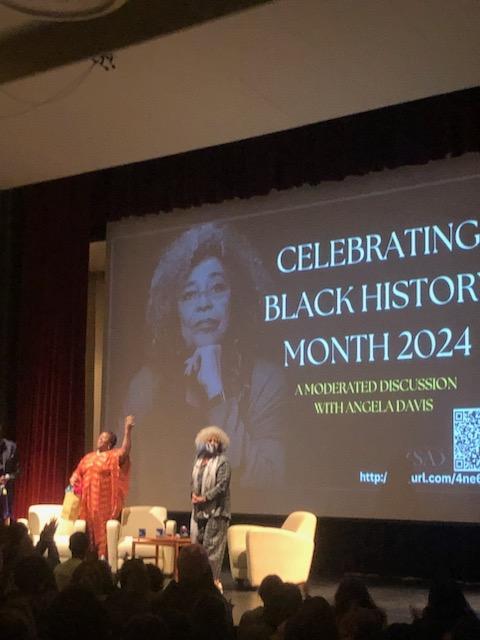


Angela Davis is a pioneer. She is a prolific Civil Rights Activist who has campaigned, fought, and sacrificed for the Black community, the imprisoned, women and many more marginalized groups through the decades. Her work transcends time and the limitations that society has placed not only on the Black community but Black women. Dr. Angie Taylor’s African American Psychology class went to see Angela Davis participate in a discussion at SUNY Geneseo last week. In that discussion, Davis outlined many things, but the most detailed were that of the importance of education, technology, and organizing. It is through these areas that Davis gave insight into her career, and how she was able to become such a trailblazer while simultaneously calling students to action.


Davis first discussed how education is key. She explained how her parents’ valued education and always wanted her to pursue education in various forms, whether that be other languages such as when her dad tried to teach her Latin words at an early age, or even education in the sense of living in a society when you are Black. Davis stressed that education is interwoven into the Black experience. Education had always been a right that was denied to Black people dating back to slavery. It was thought that if Black people were educated, they would hold so much power that the systems that held them in bondage and oppressed them, even to this day, would crumble once Black people realized the truth of their bondage. Davis then quoted Fredrick Douglass, who famously said that without education, there can be no liberation. This goes back to the dynamics of power. When an individual has education and is able to learn what they do not know about the world around them, they are then able to shape their lives and take back power that was stolen from them. This is a common theme in the Black community, that when you are uneducated and Black, you are vulnerable to societal oppression.


The next concepts discussed were technology and its use for organizing. Davis had mentioned that when she organized during the Civil Rights Era, there were no cell phones or fast ways of getting information of injustices to the public, let alone to individuals around the world. With the use of technology today, movements are not solely based in one place. Movements expand through regions and around the globe, and individuals are able to realize that problems that they think are isolated problems in their own countries are also common in other countries around the world. This creates a sense of unity and expands movements. One example given was the George Floyd murder. His murder, because of cellphones, was recorded and was spread all over the world, and because of it, mass protests and demonstrations were held in almost every place this story was shown.
However, Davis stressed that demonstrations stop happening when a movement is suspected to be over. When Black Lives Matter was at the forefront of the pandemic, and murders such as George Floyd’s were shared all over the globe, there was visibility within the Black community of the atrocities that are associated with this community. However, after COVID-19, this movement died down and wasn’t as “popular.” People love a hashtag and to feel a part of something, but there will always be the next new trend, story, and/or hashtag. What Davis stressed is that these demonstrations cannot stop, that movements do not stop even if they are no longer in the limelight, and it is up to individuals to stay committed and keep fighting for a cause.